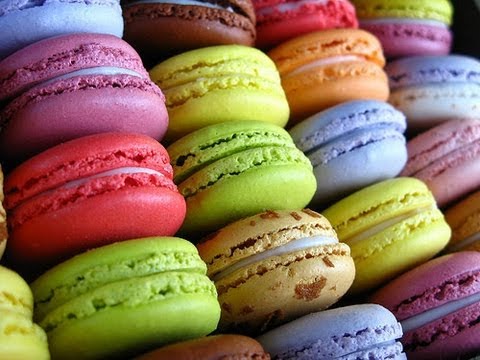
Before starting to experiment, I'm starting by getting more familiar with the background history. Including: the history of, how-to's, and other facts.
Note: These are my personal notes from the sites Les Petits Macarons, Indulge with Mimi. and Sweet and Savory by Shinee.
What should I expect from a macaron?
The shell should be shiny with an outer crunch at the first bite. Texture should not be to soft so it dissolves into the filling, or too thick that only the crust is felt.
A proportional foot around the shell of the macaron: A foot is the small ruffled lining that circles each shell.
The interior of the cookie should be "soft, moist, and only slightly chewy." The whole macaron together should not taste too sweet.
History/facts
Catherine de' Medici brought macarons to France in 1533 after marrying Henry II.
"Macaron" originates from Italian "maccherone" or "macaroni". Macarons did not just refer to a cookie, but a savory dish as well.
A French-English dictionary from 1673 refers to macarons as "'little Fritter-like Buns, or thick Losenges, compounded of Sugar, Almonds, Rosewater, and Musk, pounded together, and baked with gentle fire.'"
The macaron obviously became famous in France, where different cities evolved the popular dessert "into their own specialities."
Recipes for French macarons began in the middle of the seventeenth century.
Macarons as we know it- two shells with a filling- became popular more recently from companies such as Ladurée.
*WHAT I KNOW*
1. Macarons are French cookies made of almond flour, icing sugar, egg whites, and sugar.
2. You whip the egg whites and sugar into a stiff meringue and combine it with the flour and icing sugar in a strict technique called macaronage: carefully folding both components until the right consistency.
3. Macaron batter should not be too runny or thick, about the consistency of a thicker pancake batter. It should be a piping consistency where it doesn't spread too much once piped.
4. You let macarons sit before baking until it dries and forms a skin (where you can touch the batter and nothing sticks).
5. In the oven, the macarons should bake at a low temperature to help the rise, drying out, and forming of the feet.
6. Once cooled, the macarons can be sandwiched with a filling (i.e. buttercream, jam, curd).

No comments:
Post a Comment